The Misconception Around Operational Compliance
In many organizations, operational compliance is treated as a documentation exercise. Procedures are written, policies are distributed, and checklists are created to ensure that expectations are clear. On paper, everything appears structured and controlled. The assumption is that if processes are defined, they will be followed.
But when an audit takes place, or when an issue arises, that assumption is tested. The question is no longer whether procedures exist. It becomes much simpler, and much harder to answer:
Were they actually followed?

The Gap Between Intent and Execution
Defining processes creates intent. It sets expectations, establishes standards, and outlines how work should be performed. But intent does not guarantee execution.
In day-to-day operations, work happens across shifts, teams, and locations. Tasks are assigned, activities are scheduled, and procedures are expected to be followed. Yet without clear visibility into what actually occurs, organizations are left relying on assumptions.
This is where the gap appears. What was planned is not always what was executed. And without the ability to verify execution, organizations cannot confidently determine whether compliance truly exists.
Why Audits Fail
Audits rarely fail because organizations lack documentation. In most cases, there is no shortage of policies, procedures, or checklists. They fail because there is no reliable way to prove that those procedures were followed in practice.
When auditors ask for evidence, organizations often turn to manual logs, self-reported updates, or fragmented records pulled from different systems. Information must be gathered, interpreted, and sometimes reconstructed after the fact.
This process introduces uncertainty. Without consistent, time-stamped, and verifiable records of execution, compliance cannot be demonstrated with confidence. It becomes something that is explained rather than proven.
Operational Compliance: A Different Standard
Operational compliance shifts the focus from documentation to execution. It is not concerned with what should happen, but with what actually happens in real operational conditions. It requires visibility into whether work was performed as expected, at the right time, and in the right context.
This type of compliance is grounded in reality. It reflects how teams operate across shifts, how tasks are carried out, and how procedures are followed in practice. When organizations adopt this perspective, compliance becomes measurable. It is no longer based on assumptions or intentions, but on observable and verifiable actions.
Moving Beyond Checklists

Checklists play an important role in defining what needs to be done. They provide structure and consistency, and they help standardize operations. However, a checklist alone does not prove that work was executed correctly, or even that it was executed at all.
To move beyond checklists, organizations need visibility into execution as it happens. They need systems and processes that capture real operational activity, creating a clear and reliable record of what was done, when it was done, and by whom.
This transforms operational compliance from a static requirement into a dynamic process, one that reflects actual performance rather than intended behavior.
Compliance Doesn’t Have to Be Complex
One of the biggest misconceptions about compliance is that proving it requires complex processes, manual reporting, and time-consuming audits. It doesn’t. When operational data is connected and visible in a single place, compliance becomes significantly easier to manage. Instead of chasing information across systems or relying on manual updates, teams can access a clear, real-time view of execution.
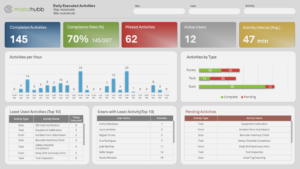
Modern operational dashboards make this possible by bringing together key elements such as shifts, tasks, activities, and incidents into one unified view. This allows leaders and supervisors to quickly understand what is happening across their operations without needing to reconstruct events. More importantly, it allows them to see where execution aligns with expectations — and where it doesn’t.
In this context, compliance is no longer a burden. It becomes a natural outcome of well-structured, visible operations.
Building Audit-Ready Operations
Audit readiness should not begin when an audit is announced. By that point, it is already too late to build reliable evidence. Instead, audit readiness must be embedded into daily operations.
Organizations that achieve this shift focus on capturing execution in real time. They maintain consistent records, reduce reliance on manual reporting, and ensure that operational data is connected and accessible.
When this foundation is in place, audits become significantly simpler. Instead of searching for answers, teams can provide clear, structured evidence of what occurred.
From Assumption to Accountability
When operational compliance is based on evidence, accountability becomes clear. Organizations no longer rely on assumptions or after-the-fact explanations. They gain the ability to see where execution aligns with expectations, and where it does not.
This visibility allows them to identify gaps, improve consistency, and strengthen operational discipline across teams and locations. More importantly, it allows them to move from reacting to issues to proactively managing performance.
Compliance Is Proven, Not Claimed
At its core, compliance is not about what is written. It is about what is done. Policies define intent. Procedures define expectations. But only execution creates reality. And in any operational environment, reality is what must be measured, verified, and, ultimately, proven.
Compliance is not something organizations declare. It is something they demonstrate through clear, consistent evidence of action.